Exploit Summit 2026 Lands in Montreal With $340M of Subnet Market Cap on Stage
Bittensor Commons takes over New City Gas on 28 and 29 September for two days of talks, debates and live subnet demos. The founders on the speaker list run subnets worth close to a third of the tracked subnet economy.
Bittensor’s own conference returns this month, and the guest list is a fair map of where the network’s money and emissions actually sit.
Exploit Summit 2026 runs on 28 and 29 September at New City Gas, 950 Rue Ottawa in Montreal, opening at 9am on the Monday and closing at 5pm on the Tuesday. It is convened by Bittensor Commons, the non-profit that describes itself as “dedicated to amplifying the visibility, understanding, and adoption of Bittensor”, alongside co-hosts Jose Rios, Etienne Leroy and Tensor Media Group.
The billing is deliberately combative. The summit’s strapline is “Break it down. Build it better.”, and the organisers frame the two days around what they call Bittensor’s signature concept, game-theoretic competitive design. The programme is pitched as a mix of talks, debates, workshops and live demos that “stress-test ideas, challenge assumptions, and evolve together in public”.
Who is on the bill
Eight speakers are named on the summit’s own site:
- Jacob Steeves, chief executive of Affine and a Bittensor co-founder
- Will Squires, co-founder and chief executive of Macrocosmos
- Steffen Cruz, co-founder and chief technology officer of Macrocosmos
- Jon Durbin, core contributor at Chutes
- Rob Myers, chief executive of Manifold Labs
- Max Sebti, co-founder and chief executive of Score
- Micaela Bazo, co-founder and chief executive of Metanova Labs
- Marcus Graichen, founder of TaoStats
What that lineup is worth on-chain
Read against the subnet register, the speaker list is not a cross-section of the network. It is concentrated at the top of it.
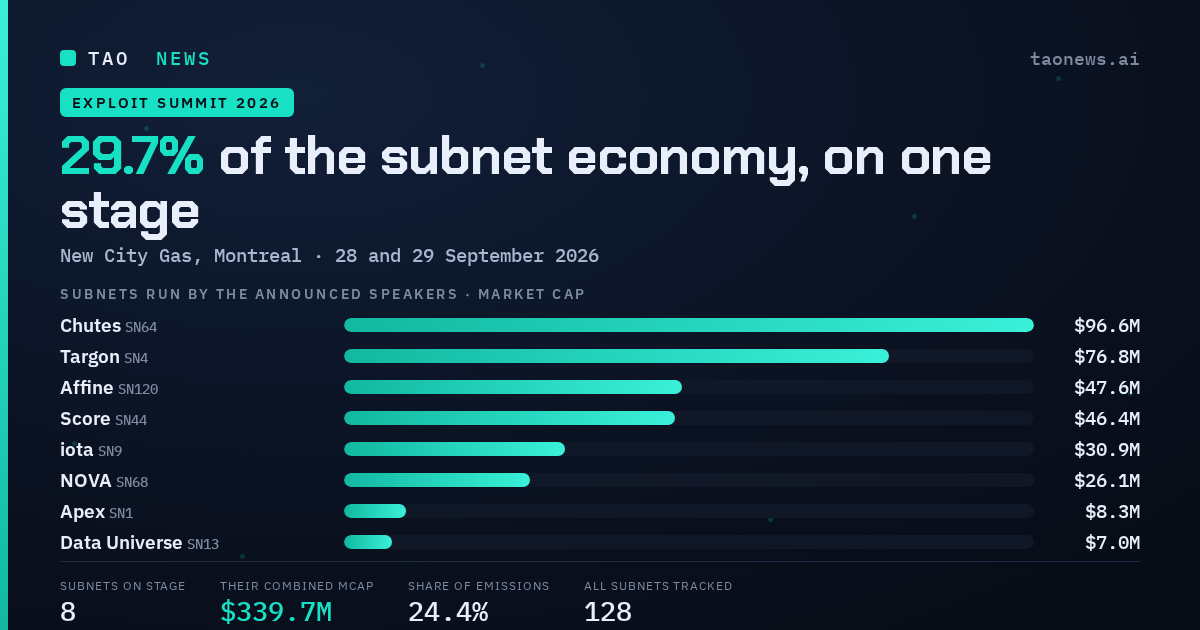
Seven of the eight organisations named above operate subnets we track. Chutes runs subnet 64, Manifold Labs runs Targon on subnet 4, Affine runs subnet 120, Score runs subnet 44, Metanova Labs runs NOVA on subnet 68, and Macrocosmos runs three: Apex on subnet 1, iota on subnet 9 and Data Universe on subnet 13.
On TaoStats figures as at 14 September, those eight subnets carry a combined market capitalisation of about $339.7m, against roughly $1.15bn across all 128 subnets in the register. That is 29.7 per cent of the tracked subnet economy in the hands of teams whose founders will be on a stage in Montreal for two days. On emissions the concentration is similar: the same eight subnets take 24.4 per cent of network emissions between them.
Four of them sit in the top five by market cap. Chutes is second at $96.6m, Targon third at $76.8m, Affine fourth at $47.6m and Score fifth at $46.4m. iota is ninth at $30.9m and NOVA tenth at $26.1m. Macrocosmos’s two older subnets sit much further down the table, Apex at 32nd and Data Universe at 35th, a reminder that a team’s standing and any single subnet’s standing are different things.
The summit’s own material claims more than 100 subnet teams across AI agents, quantum, robotics and drug discovery. The register currently holds 128, so the gathering is pitched at the whole field even if the announced speakers are drawn from its upper reaches.
The sponsors overlap with the stage
The declared sponsor list runs to Affine, Chutes, the Opentensor Foundation, TaoStats, Manifold and Score, among others. Five of those six are either represented on the speaker list or run a subnet whose founder is.
That is worth naming plainly rather than treating as a scandal. Exploit is the ecosystem’s own conference, convened by a foundation inside it, and the people funding it are the people building on it. It does mean the programme is unlikely to be a neutral survey of the network, which is more or less what the organisers have said themselves: the pitch is an argument in public, not a showcase.
Tickets, and what they cost
Registration runs through Luma. Three of the five paid tiers have closed: a $349 pre-sale for previous ticket holders, a $399 early bird that ran to 15 May, and a $499 main release that ran to 10 August.
The open tier at the time of writing is Phase 2, the final release, at $549. A student ticket is listed at $100 and needs approval, a valid university email, a university name and a student ID number, with photo ID and a matching student card required at check-in. Press accreditation is free. Tickets are non-refundable but transferable, and the event was not showing as sold out when we checked.
Day one closes with an afterparty, Exploit: The Party, free to ticket holders. The organisers list Hotel Alt Montreal, a ten-minute walk from the venue, and say discounted Air Canada fares are available. Speaking and sponsorship enquiries go to hello@exploitsummit.com, partnerships to etienne@opentensor.dev.
What to watch for
The interesting question is not who turns up but what gets conceded. A conference built on adversarial framing is only worth the name if the subnets on stage are willing to have their incentive designs picked apart by the people competing with them for emissions. Several of the teams present are direct rivals for the same compute and inference demand.
Whether the debates produce anything sharper than a product roadmap is the thing to judge in two weeks.
Disclosure: TAO News’s subnet directory and market figures are built on the TaoStats API. TaoStats is a sponsor of Exploit Summit 2026 and its founder is a named speaker. Market capitalisation and emissions figures in this article are as at 14 September 2026 and move continuously.